
AI Content and Google in 2026: What Helps SEO and What Can Hurt Your Site
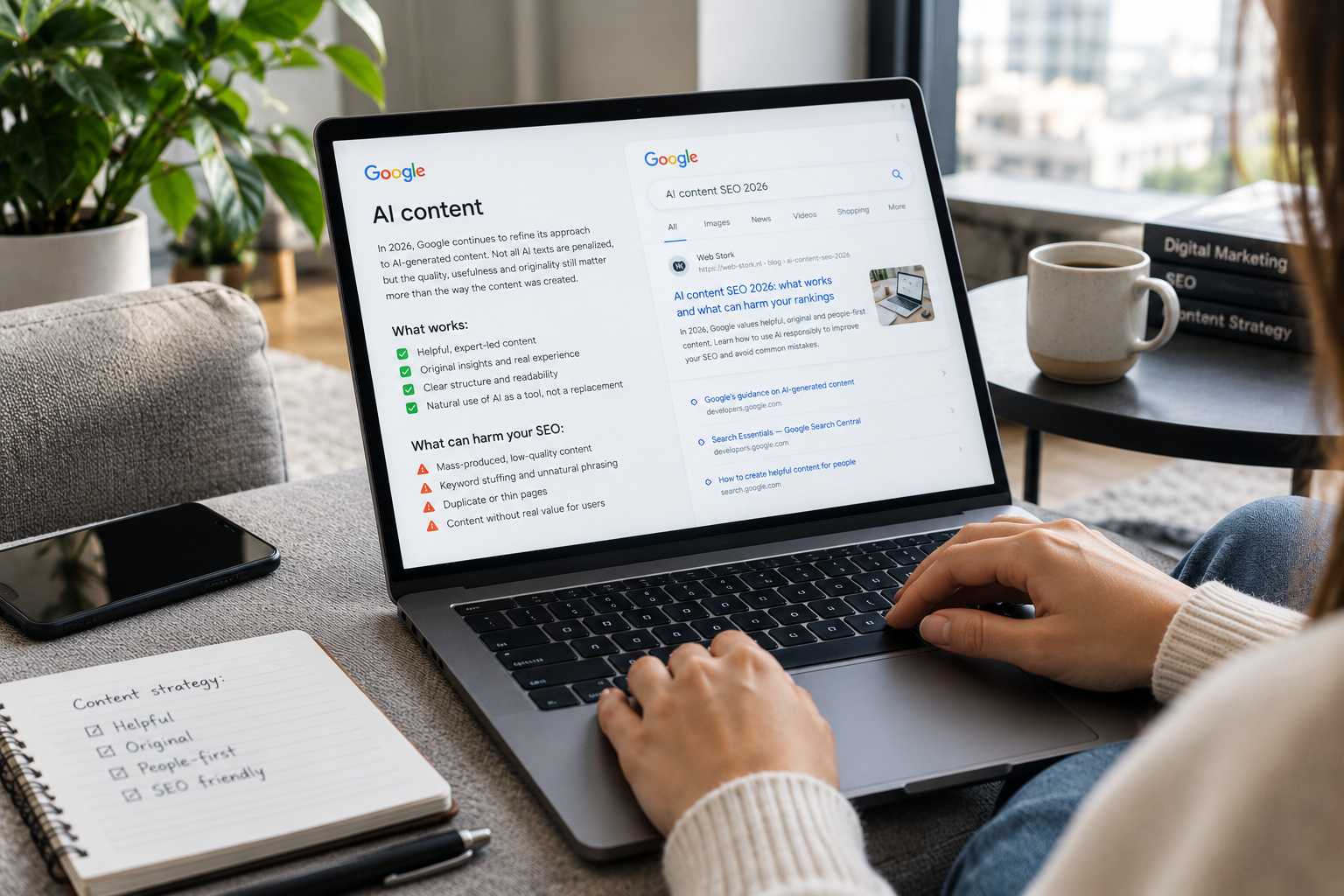
AI content can help improve a website’s Google rankings if it answers users’ questions, contains verified information, and provides practical value. Using artificial intelligence is not, in itself, a violation of Google’s policies. The risk arises when a company mass-produces pages primarily to attract search traffic without adding original information, expert insights, or value for readers.
In 2026, businesses can use AI to research topics, outline articles, analyze search queries, draft content, and edit texts. However, automated generation does not replace fact-checking, understanding the target audience, or editorial responsibility.
This article explores how Google views AI-generated content, which types of text can support SEO, which practices are best avoided, and how to build a content creation process that serves people while remaining understandable to search engines.
How Google Views AI Content in 2026
Google primarily evaluates content based on its usefulness, reliability, and relevance to users’ needs. In its guidance, the company explains that generative AI can be useful for researching a topic and developing the structure of original content. However, mass-producing pages without adding value may violate its spam policies.
This means there is no universal rule that “AI-generated texts rank lower” or “AI-generated texts automatically improve SEO.” The outcome depends on the page’s content, how it was created, and how effectively it helps users.
Can AI Be Used to Create SEO Content?
Yes. Artificial intelligence can be used at various stages of content production:
- Researching a topic and compiling a list of audience questions;
- Grouping keywords according to search intent;
- Creating an article outline and initial draft;
- Editing grammar, style, and readability;
- Preparing alternative titles and meta descriptions;
- Adapting content for different languages after translation review;
- Identifying content gaps and preparing questions for expert interviews.
For example, AI can outline an article about choosing an e-commerce platform. However, to make the content genuinely useful to readers, you need to verify platform features, current limitations, integrations, costs, and suitability for different business models.
AI can also draft a service page, but it should not invent company experience, customer results, guarantees, or technical capabilities that do not actually exist.
Practical rule: Use AI to speed up your work, not as a substitute for fact-checking, expert judgment, or understanding customer needs.
How Google Evaluates AI-Generated Content
Google does not have a universal, separate evaluation algorithm that automatically lowers the rankings of every page simply because AI was used to create it. Its guidance focuses on useful content created primarily for people.
When evaluating content, consider the following principles:
Usefulness. Does the page solve a specific problem or answer a question?
Originality. Does the content offer original insights, research, examples, data, or explanations that are not readily available elsewhere?
Accuracy. Have the facts, figures, names, links, and recommendations been verified?
Completeness. Does the reader receive enough information to take the next step, or must they search for the answer again?
Trustworthiness. Is it clear who is responsible for the content, which sources it is based on, and how its claims were verified?
These criteria align with Google’s guidance on creating helpful, reliable content.
Why Content Quality Matters More Than How It Was Created
Imagine two articles on the same topic.
The first was written by a person but contains generic statements, outdated facts, and fails to answer the reader’s main question.
The second was created with AI, but an editor checked the sources, added original analysis and specific examples, explained the limitations of the recommendations, and corrected errors.
Human authorship alone does not make the first article better, just as using AI does not guarantee the quality of the second. What matters is factual accuracy, originality, usefulness, and proper editorial work.
However, AI can confidently produce incorrect claims, invent sources, or overlook important nuances. Editorial review is therefore not a formality but an essential part of the process.
Which Types of AI Content Help Improve Website Rankings?
AI content can support SEO when it helps answer audience questions systematically, explores topics in depth, and produces high-quality material without sacrificing accuracy.
Useful Content with Expert Value
Expert value is not simply a matter of complex terminology or a large word count. It becomes evident when readers receive information they can apply in practice.
For example, an article about a technical SEO audit will be more useful if it goes beyond a list of general recommendations and explains:
- How to identify a problem;
- Which tool to use to investigate it;
- How to assess the severity of the issue;
- Which problems to fix first;
- How to verify the results after making changes.
AI can help prepare a checklist or diagnostic framework. An expert should review the logic, add necessary caveats, and ensure that the instructions reflect real-world conditions.
For Web Stork, this approach is particularly relevant to content about web development, website technical health, automation, and business digital processes.
Original Content and First-Party Data
Content becomes more valuable when it does more than summarize information that is already available.
Additional value can come from:
- Original research findings;
- Anonymized project data, where there is permission to use it;
- Comparisons of solutions based on clear criteria;
- Practical examples that explain the relevant conditions and limitations;
- Original checklists and methodologies;
- Expert commentary;
- Analyses of common mistakes and how to fix them.
For example, instead of publishing yet another article titled “10 Tips to Improve Your Website,” you could create a step-by-step guide to checking page indexing after a website migration, identifying the most common errors, and prioritizing fixes.
There is no need to invent case studies or figures to make content seem original. If you do not have your own data, it is better to create a high-quality guide based on authoritative sources and clearly distinguish verified facts from recommendations.
AI Content with Editorial Review and Expert Verification
An effective process divides responsibilities between AI and people.
| Stage | What AI Can Do | What a Human Should Check |
|---|---|---|
| Topic research | Suggest subtopics and questions | Verify relevance, accuracy, and sources |
| Structure | Develop the H1, H2, and H3 hierarchy | Ensure the structure matches search intent |
| Drafting | Prepare an initial text | Check facts, completeness, and accuracy |
| Examples | Suggest scenarios | Distinguish real cases from hypothetical ones |
| SEO optimization | Suggest a title, description, and internal links | Check content relevance and verify that URLs exist |
| Final editing | Improve readability | Preserve accurate wording, brand voice, and expert accountability |
There is no need to manually rewrite every sentence generated by AI. The editor’s job is to ensure the quality of the final content, not merely to change the wording so that it looks human-written.
Which Types of AI Content Can Harm a Website?
The main risk does not come from using the tool itself, but from a process in which the number of pages becomes more important than their value.
Mass-Producing Similar Texts
Google uses the term scaled content abuse to describe practices in which large numbers of pages are created primarily to manipulate search results rather than help users.
This can involve content created with AI, written by people, or produced through a combination of automated tools and manual work.
Examples of risky practices include:
- Creating hundreds of articles targeting different keywords without editorial review;
- Automatically rewriting competitors’ content;
- Translating pages into other languages without meaningful localization;
- Publishing nearly identical pages for different cities;
- Mass-producing product descriptions that differ only in the product name;
- Automatically generating keyword-rich texts that offer no independent value.
A large number of pages is not, by itself, a violation. A large e-commerce store may have thousands of useful product pages. What matters is whether those pages help users and whether they were created primarily to manipulate rankings.
Content Without Practical Value
Even a well-written text can be of little use if readers do not get an answer to their questions.
Common problems include:
- Introductions that take too long to reach an obvious point;
- Repeating the same conclusion across several sections;
- Generic advice without instructions or explanations;
- Unsubstantiated claims about results;
- Rephrasing other articles without adding value;
- Recommendation lists that ignore limitations or specific circumstances.
For example, telling readers to “improve website speed” is of little help without explaining how to measure it, which metrics to analyze, and which problems require a developer’s intervention.
It is better to give readers a clear sequence of actions, identify the relevant tools, explain possible outcomes, and indicate when specialist assistance is needed.
Text Written Solely to Target Search Queries
Keywords help search engines understand a page’s topic, but they should not dictate every sentence.
Problematic approaches include:
- Repeating the same keyword unnaturally;
- Inserting keywords into headings where they do not belong;
- Creating separate pages for nearly identical queries without meaningful differences in content;
- Artificially increasing the word count to meet an imagined SEO requirement;
- Publishing content simply because a topic is popular in search, without considering the audience or the website’s purpose.
Google does not prescribe a universal ideal word count for articles. Length should be determined by the complexity of the topic and the reader’s needs.
If a topic can be covered effectively in 800 words, there is no need to stretch the text to 2,500 words. If the topic is complex, a short answer may not be sufficient.
How to Use AI Correctly in SEO
To scale content production with AI without sacrificing quality, you need a repeatable process, from researching a topic to reviewing the published page.
AI as a Content Preparation Tool
AI is particularly useful for tasks that involve structuring information quickly or processing large amounts of data.
It can be used to:
- Compile a list of questions from the target audience.
- Group keywords by topic and search intent.
- Suggest an outline for an article.
- Identify questions that the draft has not yet addressed.
- Prepare a meta title and meta description.
- Check the logical flow of arguments.
- Compile a list of facts that need verification before publication.
However, AI should not be the only source of information. If content includes claims about Google policies, legal requirements, prices, technical specifications, or recent updates, verify them against primary sources.
You should also avoid sharing confidential customer data or personal information with third-party AI services unless you have an appropriate legal basis and have reviewed the relevant data-processing terms.
The Role of Experts in Creating SEO Content
Experts are not needed simply to “humanize” text. Their role is to contribute information that a model cannot reliably know without access to relevant data.
This may include:
- Assessing which recommendations actually work in a specific context;
- Explaining technical limitations;
- Choosing between several possible solutions;
- Verifying that instructions are practical to implement;
- Analyzing real-world errors and how to resolve them;
- Confirming that the company’s services and capabilities are described accurately.
If a company has no first-hand experience in a particular area, it should not imply that it has conducted research or performed relevant work. It is better to rely on trustworthy sources, clearly explain the limits of the content, and involve a qualified reviewer when necessary.
For companies looking not only to create content but also to automate content workflows, Web Stork offers AI business process automation. Automation can help organize repetitive tasks, but rules for fact-checking, quality control, and publication accountability must be established separately.
Checking Content Quality and Originality
Before publishing, review the text in several areas.
Factual accuracy
- Have dates, figures, and claims been verified?
- Do the links lead to real sources?
- Have any experience, quotations, or results been fabricated?
Originality
- Does the content contain original analysis or a useful synthesis?
- Does it duplicate other pages on the website?
- Is it merely a rephrasing of competitors’ content?
Language and readability
- Do the sentences sound natural?
- Are there repetitions, artificial expressions, or translation errors?
- Are the headings and section order easy to follow?
SEO
- Does the page match search intent?
- Are keywords used logically?
- Do internal links work?
- Do the title and description accurately reflect the content?
Trust
- Is it clear who is responsible for the content?
- Are important claims supported by appropriate sources?
- Does the text create a misleading impression of the author’s experience or expertise?
Text similarity checks can identify overlaps with other materials, but they do not, by themselves, prove a violation of Google’s policies or indicate a page’s ranking potential. Similarly, there is no basis for assuming that any AI detector can reliably determine a text’s origin or predict its search rankings.
How to Create AI Content That Supports SEO
High-quality content starts with understanding the audience and its needs, not with generating text.
Analyzing User Search Intent
Before creating an article, determine what users are trying to achieve when they enter a particular query.
The main types of search intent are:
- Informational: The user wants to understand a topic or find instructions.
- Commercial: The user is comparing solutions, tools, or providers.
- Transactional: The user is ready to order a service or purchase a product.
- Navigational: The user is looking for a specific company, website, or resource.
For example, the query “what is AI content” is primarily informational. The query “AI SEO content agency” may indicate that the user is looking for a service provider. These queries require different pages and different content.
Review the current search results, users’ questions, and competitors’ content. Then summarize the article’s main purpose in one sentence. This helps prevent unnecessary sections and keeps the content focused.
Creating a Useful Article Structure
The structure should guide readers from their main question to a practical solution.
For an informational article, the following elements are usually helpful:
- A short answer to the main question at the beginning;
- Explanations of key concepts;
- Specific examples;
- Step-by-step instructions;
- Limitations, risks, and common mistakes;
- A conclusion with recommended next steps;
- Links to primary sources and relevant pages.
Use H1 for the main topic, H2 for major sections, and H3 for subsections. There is no need to insert a keyword into every heading if doing so makes the structure unnatural.
Service pages require a different structure. They should explain the customer’s problem, the work process, the scope of the service, expected outcomes, limitations, and how to get in touch.
Optimizing Text Without Keyword Stuffing
SEO optimization helps search engines understand a page’s topic and enables readers to find the information they need more easily.
Before publication, check the following:
- Title: Clearly describes the page and distinguishes it from other content.
- Meta description: Briefly explains the value readers will receive; it does not guarantee that Google will display that exact description in search results.
- H1: Clearly reflects the main topic.
- URL: Short, understandable, and stable.
- Internal links: Lead to relevant pages that actually exist.
- External sources: Support important claims and link to trustworthy resources.
- Images: Relevant, optimized, and provided with descriptive alternative text when appropriate.
- Language versions: Have correct URLs, appropriate metadata, and properly configured
hreflangattributes when the website supports multiple languages.
Use keywords naturally. There is no need to repeat the exact phrase in every paragraph or artificially increase the text length. What matters most is that the page fully answers the user’s question.
Conclusion
AI content can be an effective part of an SEO strategy in 2026 when it is created for people, fact-checked, and enhanced with genuine expertise. Google does not prohibit generative AI, but its policies on scaled content target the mass production of pages whose primary purpose is to manipulate search results.
The best approach is to use AI for research, structuring, drafting, and repetitive tasks while leaving people responsible for accuracy, originality, practical value, and final publication.
Before scaling article production, check whether each page helps your audience, provides independent value, and reflects the business’s actual capabilities. This process makes it possible to combine the efficiency of automation with readers’ trust.


The Future of Websites: Technologies That Will Change Web Development in the Next 3 Years

Why Is Your Website Not Generating Leads? 10 Common Reasons and How to Fix Them

Why Is Your Website Loading Slowly and How Can You Improve Its Performance?

Does Your Business Need a New Website, or Is Improving the Existing One Enough?

A Beautiful Website ≠ A Profitable Website: What Actually Drives Online Sales